WhiteHaX OptimalAI Testing

Response-Time Measurement & Performance Optimization for Business AI Deployments

Overview

WhiteHaX OptimalAI Testing is a comprehensive performance testing and optimization service designed to ensure business-critical AI applications deliver fast, reliable, and consistent user experiences. As AI-powered applications become core to enterprise workflows, response time, scalability, and infrastructure efficiency directly impact customer satisfaction, productivity, and operational cost.

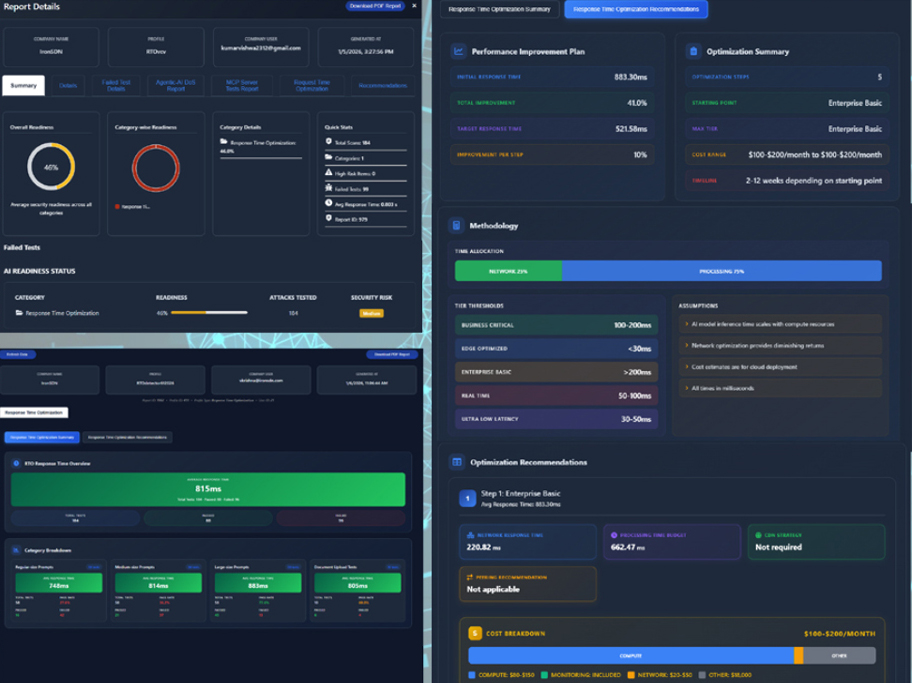
OptimalAI Testing evaluates AI deployments under real-world and extreme conditions, measuring response times, system behavior, and infrastructure limits. Based on these insights, the service delivers detailed, actionable optimization recommendations across compute, memory, instance sizing, networking, and quality-of-service layers—enabling organizations to continuously optimize AI performance as usage grows.

Businesses can use OptimalAI Testing periodically or as part of pre-production validation to ensure their AI systems remain performant, resilient, and cost-efficient.

Key Objectives

  • Measure end-to-end AI response time under realistic and adversarial conditions
  • Identify performance bottlenecks across application, infrastructure, and network layers
  • Validate scalability and resilience of AI deployments under load
  • Provide prescriptive recommendations to reduce latency and improve user experience
  • Enable continuous optimization of AI-powered business applications

Testing Capabilities


1. Different Size User Prompt Testing

OptimalAI Testing evaluates AI system behavior across a wide spectrum of prompt sizes, structures, and response-generation patterns to accurately reflect real-world usage and edge cases.

    Test categories include:
  • Regular Prompts: Short, transactional user queries with concise responses
  • Medium-Response Prompts: Prompts designed to generate structured or multi-paragraph outputs
  • Large-Response Prompts: Long-context prompts that trigger extensive reasoning, summaries, or multi-section outputs
  • Complex / Chained Prompts: Multi-turn or instruction-heavy prompts stressing context windows
    What is measured:
  • Prompt ingestion and preprocessing latency
  • Token consumption and inference execution time
  • Response generation time and streaming behavior
  • Throughput impact as prompt size and response size scale
    Value to business:
  • Ensures predictable response times across diverse user interactions
  • Identifies prompt-size thresholds that degrade performance
  • Informs prompt handling, truncation, and context-management strategies


2. Document Upload Testing

This testing evaluates AI performance during document ingestion and knowledge-processing workflows, which are critical for RAG, summarization, analytics, and enterprise AI use cases.

    Test coverage includes:
  • Various document types (PDF, DOCX, TXT, CSV, JPG, QR-Codes and others)
  • Small, medium, and large document sizes
  • Single and concurrent document upload scenarios
    What is measured:
  • Upload latency and preprocessing time
  • Parsing, embedding, and indexing duration
  • CPU, memory, and storage utilization during document handling
  • End-to-end response time for document-based queries
    Value to business:
  • Prevents performance degradation during document-heavy workloads
  • Validates scalability of ingestion and indexing pipelines
  • Optimizes document processing for enterprise-scale AI deployments


3. Heavy Load Testing (DoS-Style Stress Scenarios)

OptimalAI Testing simulates extreme load and adversarial traffic patterns to evaluate AI system resilience, security posture, and cost stability under stress.

    Test scenarios include:
  • Resource Exhaustion: Sustained high concurrency stressing CPU, memory, GPU, and network limits
  • Cost Amplification Attacks: Prompt patterns designed to maximize token usage and inference cost
  • Token Overflow & Rate-Limit Bypass Attempts: Testing safeguards around token limits, quotas, and throttling
  • Multi-Session Memory Exhaustion Parallel sessions designed to stress context retention and memory usage
  • Burst Traffic & Spike ScenariosSudden surges in requests simulating flash events or abuse
    What is measured:
  • Response-time degradation under heavy load
  • Resource exhaustion and throttling behavior
  • Error rates, timeouts, and request queuing
  • Cost impact and system recovery time after peak stress
    Value to business:
  • Identifies breaking points before real-world incidents occur
  • Improves reliability, security, and cost predictability
  • Strengthens defenses against abuse and denial-of-service conditions


4. Response Time Measurement Under All Conditions

OptimalAI Testing provides holistic response-time measurement across all test scenarios, capturing both average and tail latency.

    Metrics captured include:
  • End-to-end response time (user to AI and back)
  • P50, P90, P95, and P99 latency
  • Throughput and concurrency handling
  • Error rates and timeout frequency
    Value to business:
  • Clear visibility into real user experience
  • Identification of latency outliers impacting satisfaction
  • Data-driven performance baselines for continuous improvement

AI Abuse & Cost Risk Analysis

Modern AI deployments face not only performance risks but also abuse-driven cost escalation and service degradation. WhiteHaX OptimalAI Testing includes a dedicated AI Abuse & Cost Risk assessment to identify how malicious or unintended usage patterns can impact availability, performance, and operating cost.


Risk areas analyzed include:

  • Cost Amplification via Prompt Abuse: Prompts engineered to maximize token usage, inference duration, or downstream processing cost
  • Token Overflow Exploits: Attempts to exceed or abuse context window limits leading to failures or degraded performance
  • Rate-Limit & Quota Bypass: Stress testing throttling, quota enforcement, and abuse-prevention controls
  • Multi-Session Memory Abuse: Parallel sessions designed to exhaust memory, context retention, or session caches
  • Sustained Load Abuse (DoS-like Conditions): Long-duration traffic designed to inflate cloud spend while reducing service quality

Outcomes:

  • Identification of abuse vectors that drive unexpected AI spend
  • Visibility into performance degradation under malicious or negligent usage
  • Actionable controls to limit financial and operational risk

Test Types Mapped to Business Impact & KPIs

FeatureBusiness Impact Key KPIs
User Prompt Size & Response Testing
  • Ensures consistent user experience across all prompt types
  • Prevents latency spikes that reduce customer satisfaction
  • Controls inference cost driven by large or complex prompts
  • P50 / P95 / P99 response latency
  • Tokens processed per request
  • Cost per inference
  • Throughput (requests per second)
Document Upload & Processing Testing
  • Maintains productivity for document-driven AI workflows
  • Prevents ingestion bottlenecks that delay insights
  • Avoids infrastructure overprovisioning
  • Document processing time
  • End-to-end query response time
  • CPU and memory utilization
  • Error and retry rates
Heavy Load & DoS-Style Stress Testing
  • Protects availability during traffic spikes or abuse events
  • Prevents unexpected cloud cost surges
  • Improves resilience of customer-facing AI services
  • Latency degradation under load
  • Maximum sustainable concurrency
  • Error and timeout rate
  • Cost per hour under stress
AI Abuse & Cost Risk Testing
  • Reduces financial exposure from prompt abuse and misuse
  • Improves governance and predictability of AI spend
  • Strengthens trust in AI service reliability
  • Token consumption per user/session
  • Cost amplification ratio
  • Rate-limit violation frequency
  • Memory exhaustion thresholds
Optimization & Recommendation Framework

Following testing, WhiteHaX delivers full-scale, actionable optimization recommendations tailored to the specific AI deployment architecture.


    Compute & Memory Optimization
  • CPU and GPU sizing recommendations
  • Memory allocation and caching strategies
  • Identification of compute bottlenecks during inference
    Instance & Deployment Optimization
  • Instance type and size right-sizing
  • Horizontal vs. vertical scaling strategies
  • Container and orchestration tuning (where applicable)
    Network Optimization
  • Network latency and bandwidth optimization
  • Load balancer and routing efficiency
  • Regional and edge placement recommendations
    QoS & SD-WAN Configuration Guidance
  • Quality of Service (QoS) policies for AI traffic prioritization
  • SD-WAN configuration recommendations for distributed users
  • Latency and jitter reduction strategies
    Cost-to-Performance Alignment
  • Eliminating over-provisioned resources
  • Balancing performance targets with infrastructure cost
  • Recommendations for sustainable scaling
    Deliverables

    Each OptimalAI Testing engagement includes:


  • Detailed response-time and load-testing report
  • Bottleneck analysis across application, compute, and network layers
  • Clear performance baselines and stress thresholds
  • Prioritized optimization recommendations
  • Executive summary for business and technical stakeholders
    Use Cases

  • Pre-production validation of AI applications
  • Periodic performance optimization for live AI systems
  • Enterprise AI deployments with global users
  • High-availability and customer-facing AI services
  • Cost optimization for large-scale AI inference platforms
    Business Benefits

  • Faster and more consistent AI user experiences
  • Improved reliability under peak demand
  • Reduced infrastructure waste and operational cost
  • Proactive identification of performance risks
  • Continuous optimization as AI usage evolves
Summary

WhiteHaX OptimalAI Testing enables organizations to confidently deploy and scale AI applications with predictable performance and exceptional user response times. By combining rigorous response-time measurement with expert optimization recommendations, businesses gain the insight and guidance needed to keep AI systems fast, resilient, and cost-efficient—today and as demands grow.